Update — September 15, 2026. This article describes an earlier product direction. FiloMail now focuses on email; the broader cross-service agent roadmap below has been retired. Read the current product update.
Think about the things you actually got done last week. The contract you redlined. The client you finally responded to. The trip you booked because someone moved the kickoff. The invoice you approved on Friday because the vendor was about to follow up again.
Now open your to-do app and see how many of them were ever in there.
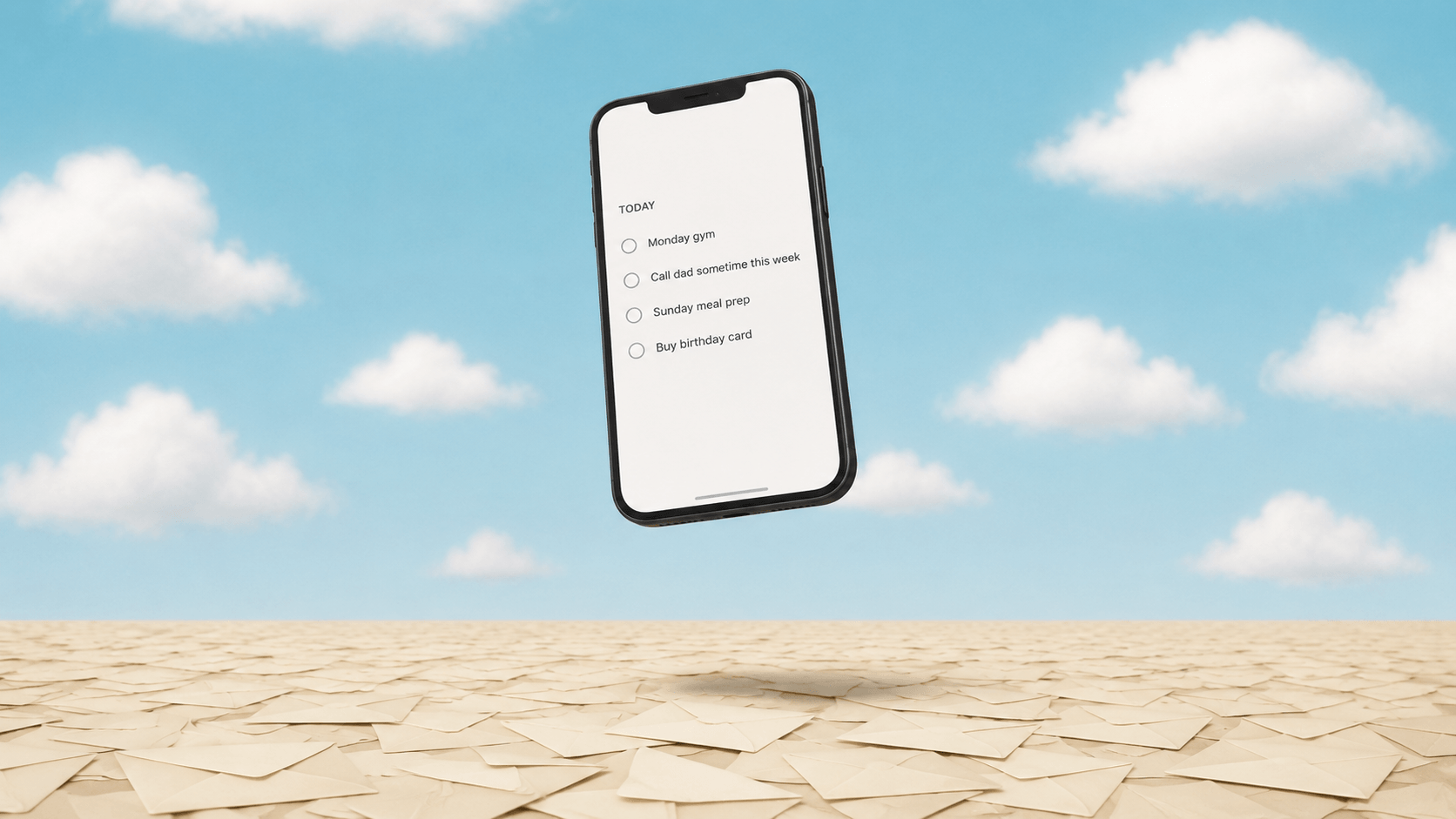
Probably almost none. Most of your real to-dos are hiding in your inbox, and they have been for years. The to-do list on your phone knew about Monday's gym plan and a note to "call dad sometime this week." It had no idea about the contract. It had no idea about the trip. It had no idea about the invoice, even though the email about it had been sitting in your inbox for nine days.
This is the quiet failure that every productivity tool has been built on top of for the last ten years. The to-do list captures what you remember to type. Most of your real work never makes it that far. It lives one tab over, in your inbox, in a Slack thread, in a notification you swiped away on your lock screen.
The to-do app was never the problem
It is easy to blame the apps. Things, Todoist, TickTick, Notion, Apple Reminders. Each one prettier than the last, each one bought hopefully on a Sunday evening, each one quietly abandoned by Wednesday.
The apps are fine. The checkbox is one of the cleanest pieces of UI ever invented. The problem is structural. Every one of them is built as a passive container. You feed it. It displays. Whatever you forget to feed it stops existing.
That model only works if the only things in your life are the ones you remember to write down. For anyone whose day is shaped by other people's messages, that is a tiny slice of reality. A list built by one tired person on a Sunday evening cannot keep up with a week being authored by twenty other people. Add three calendars, a shipment tracker, and an inbox doing six hundred sends on a quiet day, and the list goes stale in hours.
So trust drops. You stop opening the app. The next month you try a different one. The cycle is universal because the design is universal.
Look at your inbox as a queue
There is a simple exercise that changes how you think about all of this. Open your inbox and stop reading it as messages. Read it as a list of pending decisions.
A flight confirmation is a decision: book the hotel before the price moves. A client reply is a decision: respond by Friday, loop in legal, send the draft. A shipment update is a decision: tell the customer, push the warehouse, reschedule the courier. A tuition email is a decision: pay by the 28th, attach the transcript. A GitHub mention is a decision: review tonight or it slips a sprint. An invoice is a decision: approve, file, route.
Almost every meaningful thing in your week has a corresponding message sitting in there. The to-do list, designed to catch your work, has been sitting next door to the actual source the whole time and has never been allowed to read it.

That gap is the entire opportunity.
What changes when an AI agent reads the other side
For a long time, this gap was just a fact of life. Email is messy. Conversation is ambiguous. A "let's circle back next week" can be a real commitment or a polite goodbye, and no rules engine has ever reliably told the difference.
What has shifted in the last two years is that this is no longer a research problem. Models can read a thread and hold the context of who a sender is to you. They can weigh deadlines against the rest of your week. They can tell the difference between a marketing newsletter and a contract that needs a signature by Tuesday. The pieces are tractable now in a way they were not even eighteen months ago.
This is what Filo is being built around. Today the product is an AI assistant that lives next to your inbox. You can ask it what needs your attention. You can ask it to draft a reply. You can ask it to pull the real action items out of a long thread you do not have time to re-read. It already creates and closes to-dos in the background as you handle the work, and it suggests ones you would have missed.
That is the first floor. The direction we are walking in is one where the agent takes on more of the work that sits between noticing and deciding. The part you spend time on is only the part that genuinely needs your judgement. The pace will be steady rather than dramatic. Every step has to feel trustworthy before the next one is unlocked, which is why a human still approves the things that actually matter. We are not trying to ship a black box that sends your emails for you.
Email is the first source, not the only one
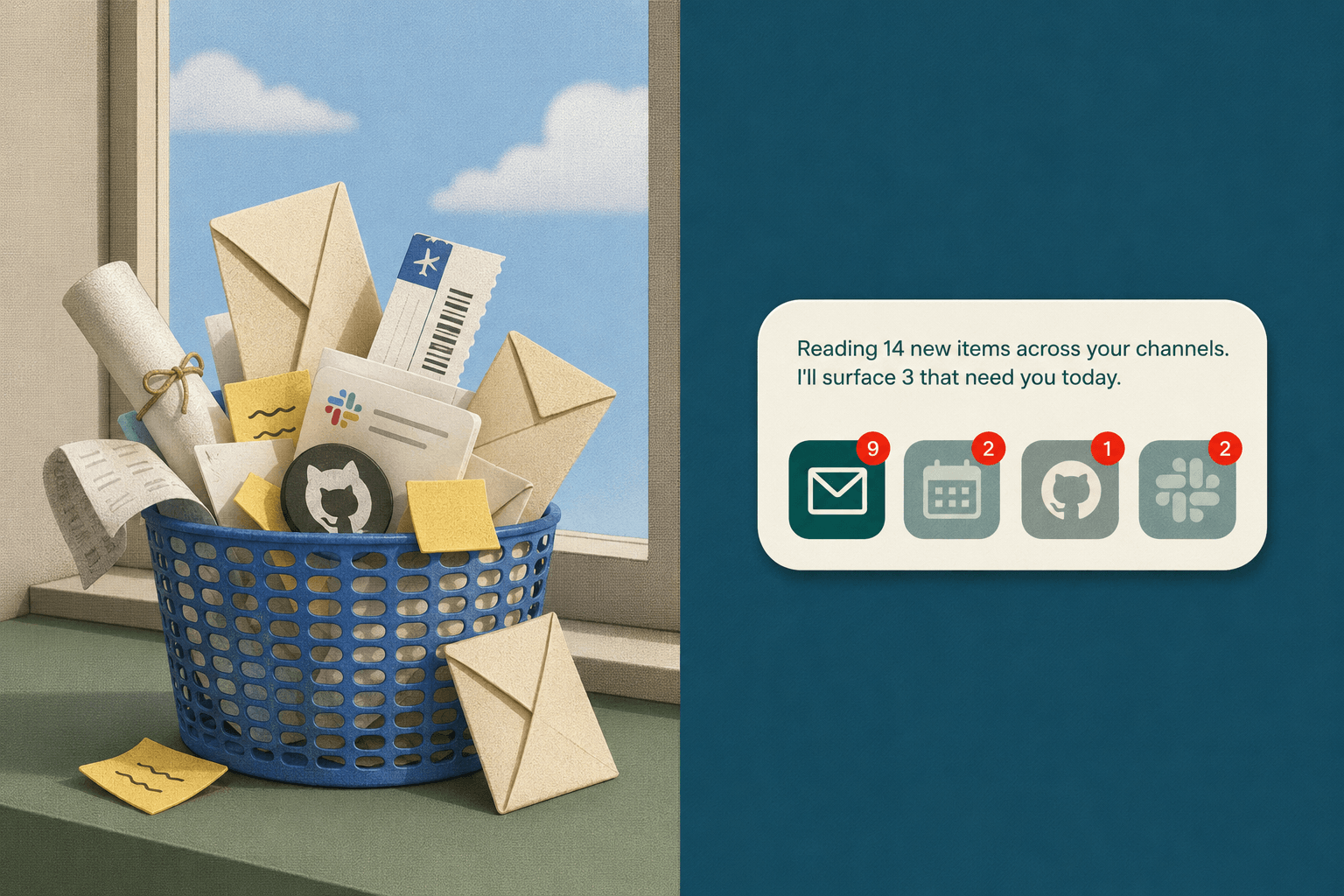
We started with email because that is where most of the work people do not have time for already lives. Bills, contracts, flight changes, client replies, deadlines that quietly arrived while you were in a meeting. For most knowledge workers and increasingly for most consumers, the inbox is the single largest pile of unfinished decisions in any given day. If the goal is to actually reduce how much of that pile you have to handle manually, it is the most honest place to start.
We are not building another email app. There are already good ones, and we use them ourselves. What we are after is something a layer up: an assistant that can read what arrives in your inbox, make sense of it on your behalf, and eventually do the same across every other place your work shows up.
But the same pattern holds everywhere your work gets coordinated. GitHub mentions and review requests. Linear and Jira tickets someone tagged you on. Slack threads where a question is still waiting for you. Notion comments. Calendar invites that quietly require prep. Shipment notifications, bills, tuition deadlines, flight changes, hotel confirmations, payment alerts.
Each of those is another inbox, just shaped differently. The vision is for Filo to be the place where all of them converge into one queue, with one agent reading across all of it, doing the boring parts, and bringing the few real decisions to you in a form you can act on in seconds.
That part is not done yet. It is what we are working toward, in roughly the order of how much pain each source causes.
A to-do list that finally knows what is going on
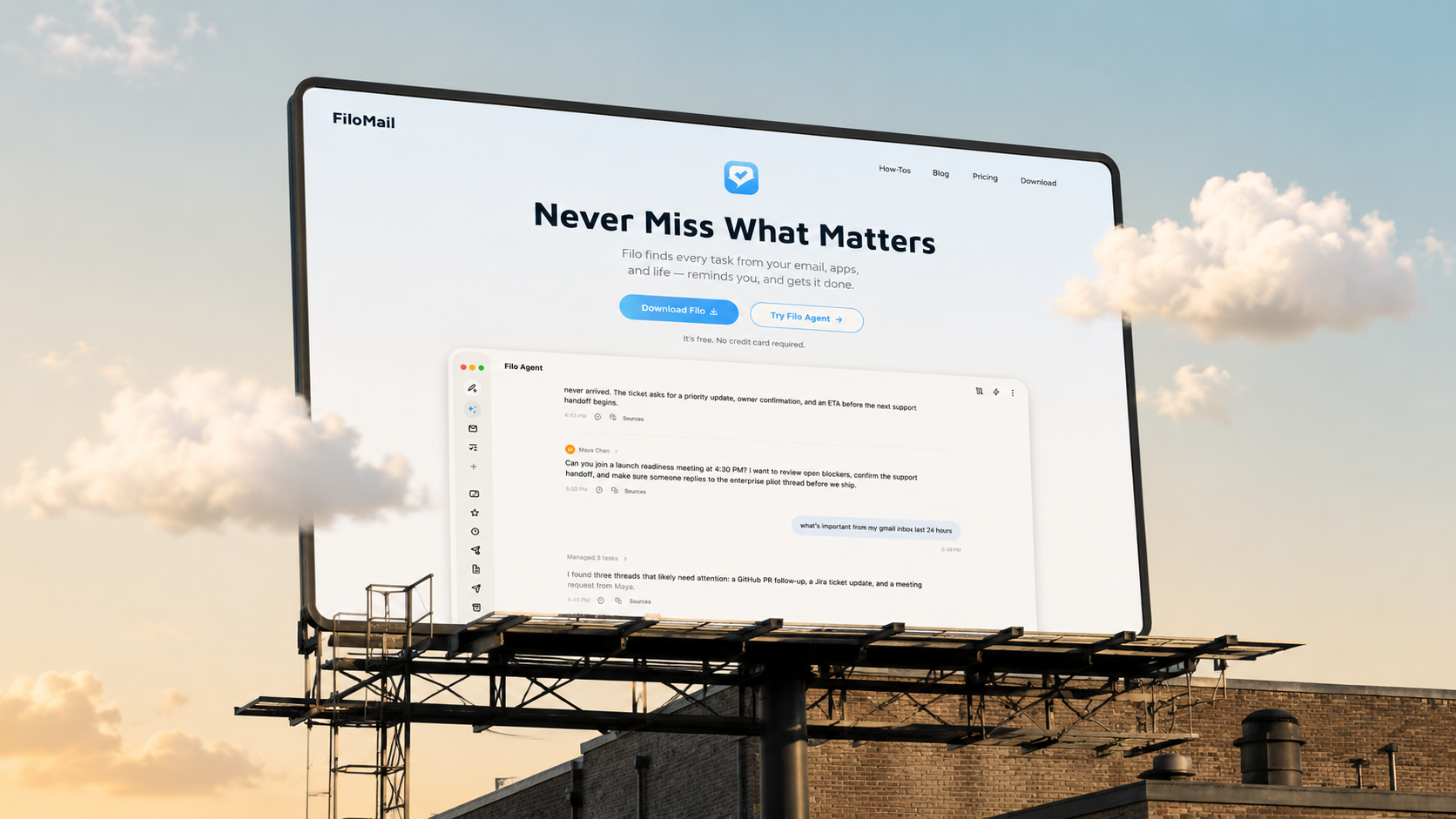
The check mark stays. The list stays. We have no interest in asking anyone to learn a new metaphor for productivity. The to-do list is one of the few pieces of UI every person on earth already understands, and a lot of what people love about it is the simple satisfaction of seeing something get completed.
What we are changing is what sits underneath. A to-do list that reads your inbox the way you would, if you had a few extra hours a day. A to-do list that adds the items you would have added if you had remembered. A to-do list that closes the ones you finished without you having to tap them. A to-do list that knows what is going on around you and stops pretending it can stay accurate while you alone do all the work of feeding it.
That is the version we are building toward. Email is where we started because it is where most of the unmanaged work already lives. The rest of your week will follow.
If that sounds like the productivity tool you have been quietly waiting for, we would love for you to try the floor we have built so far, and to grow with us as the rest takes shape.
Growth Lead at FiloMail